

 Last week, The New York Times published a feature by Lydia DePillis titled “America’s Farms Depend More Than Ever on a Troubled Visa Program.” The article shines a light on the fact that the U.S. food supply is deeply dependent on the H-2A guest worker program, which is fraught with issues from fraud to abusive labor practices.
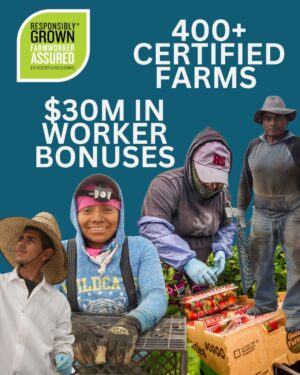
The article includes information about the Ethical Charter Implementation Program (ECIP); EFI’s Responsibly Grown, Farmworker Assured certification, which is active across more than 400 farms and has generated $30+M in worker bonuses; and EFI’s FLC certification.
DePillis initially reached out to inquire about the recently launched module in ECIP for farm labor contractors, which extends the assessment, learning and improvements of ECIP from suppliers and growers to also include FLCs. The discussion provided us a great platform to share how EFI is working proactively with the industry to build a safer, more accountable supply chain for workers through its certification and assessment programs dedicated to continuous improvement.
As with any complex issue, a single article only skims the surface of the layers of agricultural labor, so I am using this space to offer additional context and continue the conversation. Building alignment throughout the supply chain doesn’t happen instantly. It takes time for clear market signals to filter down from retail buyers to the field, and operations require a realistic runway to account for the necessary time and resources.
The article highlights the difficult nature of managing agricultural labor within the supply chain, which underscores exactly why programs like ECIP that can scale across the entire fresh produce and floral industry, ensure continuous improvement, and showcase existing social responsibility compliance programs are so vital. ECIP also helps the industry align on social responsibility reporting across multiple buyers without requiring a traditional third-party audit, an effort that would be impossible to implement across every single farm and within the tight margins of fresh produce.
Although only in its third year, ECIP has brought together six major buyers, nearly 500 suppliers and 3,500 farms and has already begun shaping meaningful market incentives. It is already signaling to retailers which growers and suppliers are willing to engage around labor management systems and continuous improvement. Importantly, ECIP creates the industry’s first mechanism to formally recognize and reward operations that have voluntarily stepped forward to achieve a social certification. It also gives retail buyers a common place to view where their supply chain is investing in social responsibility and where additional support may be needed. EFI issues an ECIP annual report to the industry on such progress and trends.
DePillis’ article arrived just one month before new ECIP criteria will roll out to generate clearer market signals across the supply chain.
Beginning in July with ECIP’s new Engagement 3.0 criteria:
- Growers will be recognized in ECIP when they engage their FLCs in the program or by uploading approved ethical recruitment documentation.
- Suppliers will only receive the highest level achievement of a gold star in ECIP when a significant majority of their growers successfully engage FLCs in reporting and assessments.
EFI’s FLC certification has only been achieved by one company to date, AgSocio. As DePillis noted, the lack of market signals has delayed adoption of this program, and while it is true that cost is also a barrier, The New York Times article cited an overblown estimate of that cost. Matt Rogers, founder of AgSocio, puts the annual cost at under $20,000. While that is by no means an insignificant amount for an industry with tight margins, it is a cost that can more easily be recouped with the growing market recognition and increasing incentive that ECIP provides starting in July.
True transformation in agricultural labor management won’t happen overnight, and there is no simple answer to resolve these complex supply chain dynamics. But ECIP, which has been backed in funding by the Walmart Foundation and is guided by a group of industry stakeholders, is acknowledging vulnerabilities in the supply chain, meeting employers where they are, and providing the tools to strengthen labor management systems across the fresh produce and floral industry.
Written by LeAnne Ruzzamenti, EFI’s director of marketing and communications